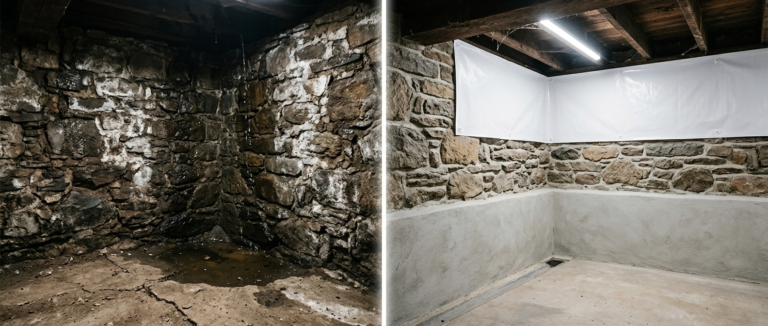
The Ultimate Guide to Basement Waterproofing Northeast PA
Protecting Your Home from Moisture, Mold, and Structural Damage
For homeowners living in Northeast Pennsylvania, a basement is often much more than a dark storage area under the house. It is a foundational space that supports the weight of your entire property, anchors your mechanical systems, and frequently serves as a workshop, laundry room, or finished living space. However, because of our region’s unique geography, weather patterns, and historic architecture, maintaining a dry basement is a persistent challenge.
From the historic urban centers of Scranton and Wilkes-Barre to the elevated terrains of Hazleton and the Pocono region, local properties are locked in a continuous battle against groundwater. When moisture breaches your foundation, it triggers a cascading sequence of problems: peeling paint, rotted floor joists, toxic mold colonies, and compromised structural stability.
If you are dealing with a damp, musty, or actively leaking lower level, understanding the mechanics of water intrusion is the first step toward reclaiming your home. This comprehensive guide details the causes of regional water issues, identifies key warning signs, highlights the health risks of hidden moisture, and outlines the most effective basement waterproofing Northeast PA homeowners can rely on for permanent protection.
Why Northeast Pennsylvania Homes Suffer from Basement Water Problems
To understand why basement water problems are so incredibly prevalent in our corner of Pennsylvania, we have to look closely at three main factors: our regional weather, our local soil composition, and the historical methods used to construct our homes.
The Double Whammy of Heavy Rain and Rapid Snowmelt
Northeast Pennsylvania experiences a highly dynamic climate. We are no strangers to intense spring downpours, severe summer thunderstorms, and heavy winter snowpacks. The real trouble begins when these weather patterns overlap.
During late winter and early spring, the Pocono region often experiences rapid temperature spikes. When inches of dense snowpack melt simultaneously with a heavy spring rainstorm, the ground is suddenly inundated with thousands of gallons of surface water. Because the deeper layers of soil may still be partially frozen, this water cannot drain downward naturally. Instead, it moves laterally across the landscape, searching for the path of least resistance—which often leads directly through the porous walls of your basement.
The Mechanics of Hydrostatic Pressure
The soil throughout Lackawanna, Luzerne, and Monroe counties contains a very high concentration of clay. Unlike sandy soils that allow water to drain away quickly, clay soil acts like a massive underground sponge. It absorbs water, expands significantly, and holds onto moisture for extended periods.
When clay soil becomes completely saturated by rain or snowmelt, it creates a phenomenon known as hydrostatic pressure.
Hydrostatic Pressure = p x g x h
As the water table rises around your home, the weight of the saturated soil exerts immense physical force against your foundation walls and upward against your concrete floor slab. This pressure is relentless. Over time, it will inevitably find any microscopic crack, cold joint, or gap in your foundation, pushing water through solid concrete and causing severe foundation water leaks.
       Ground Level (Saturated Clay Soil)
               │
               ▼  [Hydrostatic Pressure Pushing Inward]
       █████████████████  ◄── Foundation Wall
       █               █
       █   Basement    █  ◄── Water forced through cracks
       █    Space      █      and the floor-wall joint
       █               █
       █████████████████
               ▲
               │  [Hydrostatic Pressure Pushing Upward]
Regional Architecture: Old Stone Foundations and Cinderblocks
The age of our local housing stock plays a massive role in why so many homeowners find themselves searching for wet basement repair solutions. Many homes in older coal-mining towns or established urban neighborhoods were built over a century ago using fieldstone, river rock, or early concrete masonry units (cinderblocks).
- Fieldstone Foundations: Built by layering irregular stones held together with a soft lime mortar, these foundations are naturally porous. Over decades, groundwater dissolves the lime mortar, causing it to crumble away. This leaves open voids between the stones where water can freely pour into the basement.
- Cinderblock Foundations: Hollow concrete blocks are common in mid-century homes throughout Stroudsburg and Hazleton. These blocks are highly absorbent. Water can seep into the exterior face of the block, fill up the hollow center cores, and slowly bleed through to the interior wall, causing chronic dampness and structural weakening.
Critical Warning Signs of Foundation Water Leaks
Too many homeowners ignore their basements until they walk downstairs into a completely flooded room. However, your foundation will almost always drop subtle clues that a water problem is developing long before a catastrophic flooding event occurs. Recognizing these warning signs early can save you thousands of dollars in structural remediation.
1. Efflorescence (White, Powdery Glistening Residue)
If you notice a white, powdery, or sparkling chalk-like substance on your brick, stone, or cinderblock walls, you are looking at efflorescence. As water travels through the porous foundation material from the outside, it dissolves natural minerals and salts locked within the masonry. When the water reaches the dry interior air, it evaporates, leaving the crystalline salt residue behind. While efflorescence itself isn’t dangerous, it is an undeniable footprint of active moisture migration.
2. Musty, Earthy Odors
Your nose is often your best diagnostic tool. If walking down your basement stairs feels like stepping into a damp cave, you have a water problem. That classic “old basement smell” is actually the off-gassing of mold spores and mildew actively feeding on hidden organic matter, such as wooden floor joists, drywall backing, or cardboard storage boxes.
3. Hairline Wall and Floor Cracks
Hydrostatic pressure causes foundation walls to bow slightly inward and basement floors to lift. This stress results in hairline cracks running horizontally along mortar joints or spider-webbing across the concrete floor. Even a tiny crack is a structural vulnerability; water under pressure will eventually widen these gaps to create active leaks.
4. Flaking Parge Coats and Peeling Paint
Many older stone basements feature a parge coat—a thin layer of mortar applied over the stone to create a smooth surface. When water saturates the stone from behind, it destroys the bond between the stone and the mortar, causing the parge coat to flake, bubble, and crumble to the floor. Similarly, regular wall paint will bubble, peel, and blister when moisture pushes outward from the masonry.
Common Signs Checklist
| Warning Sign | What It Looks Like | What It Actually Means |
|---|---|---|
| Efflorescence | White, powdery crystals on masonry walls | Water is traveling completely through the foundation wall. |
| Parge Flaking | Crumbling mortar dropping at the base of walls | Moisture is breaking down the structural bond of your masonry. |
| Horizontal Cracks | Long cracks running along block mortar lines | Severe lateral hydrostatic pressure is bowing your walls inward. |
| Floor Seepage | Water bubbling up through floor cracks | The local water table has risen higher than your basement floor slab. |
The Hidden Dangers: Health Risks and Mold Concerns
A wet lower level is far more than a simple inconvenience or an aesthetic issue; it represents a genuine hazard to your family’s health and the structural integrity of your entire home. Ignoring chronic moisture can lead to long-term consequences that reach far beyond the basement floor.
Toxic Mold Growth and Indoor Air Quality
Mold spores exist naturally everywhere in the atmosphere, but they require three distinct ingredients to colonize and multiply: a dark space, an organic food source (like wood, paper, or drywall), and moisture. A damp basement provides the perfect breeding ground.
Once mold takes root, it releases millions of microscopic spores and volatile organic compounds (VOCs) into the air. Because of a scientific principle known as the Stack Effect, the air in your home acts like a chimney. Warm air rises out of the upper levels of your house, creating a vacuum that pulls cold, damp air upward from the basement through floorboards, utility penetrations, and HVAC ductwork.
$$\text{Air Exchanged Via Stack Effect} \approx 30\% \text{ to } 50\% \text{ of Upper-Level Indoor Air}$$
This means that up to half of the air you breathe in your living room, kitchen, and bedroom originates directly from your damp basement. If your basement is full of toxic mold, your family is constantly inhaling mold spores, which can trigger:
- Chronic respiratory infections and sinus inflammation.
- Severe asthma attacks, particularly in children and the elderly.
- Persistent headaches, fatigue, and skin rashes.
- Allergic reactions characterized by itchy eyes, coughing, and sneezing.
       ▲  [Warm Air Escalates & Escapes Top Floors]
       │
   ┌───┴───┐
   │ Living│  ◄── Inhaling basement mold spores
   │ Space │      pulled up into living quarters
   ├───┬───┤
   │   ▲   │  ◄── The Stack Effect pulls air upward
   │   │   │      through flooring gaps
   ├───┴───┤
   │ Damp  │  ◄── Mold colonization flourishes
   │Base't │      on damp wood, drywall, and dust
   └───────┘
Wood Rot and Structural Failure
When humidity levels in a basement remain consistently above 60%, the wooden architectural components of your home begin to absorb that ambient moisture. Over time, this dampness triggers wood rot.
The floor joists and main support beams that carry the weight of your home will soften, lose their structural capacity, and begin to sag. This structural decay manifests upstairs in the form of slanting floors, sticking doors, cracking drywall, and mysterious gaps opening along your baseboards.
Professional Flooded Basement Solutions and Repair Systems
When it comes to permanent flooded basement solutions, superficial quick fixes like waterproof paints or DIY caulking will never suffice. These methods merely trap water inside the foundation walls, speeding up the deterioration of your masonry. To truly solve a water problem, you must implement engineered systems that manage, redirect, and expel groundwater safely away from your home.
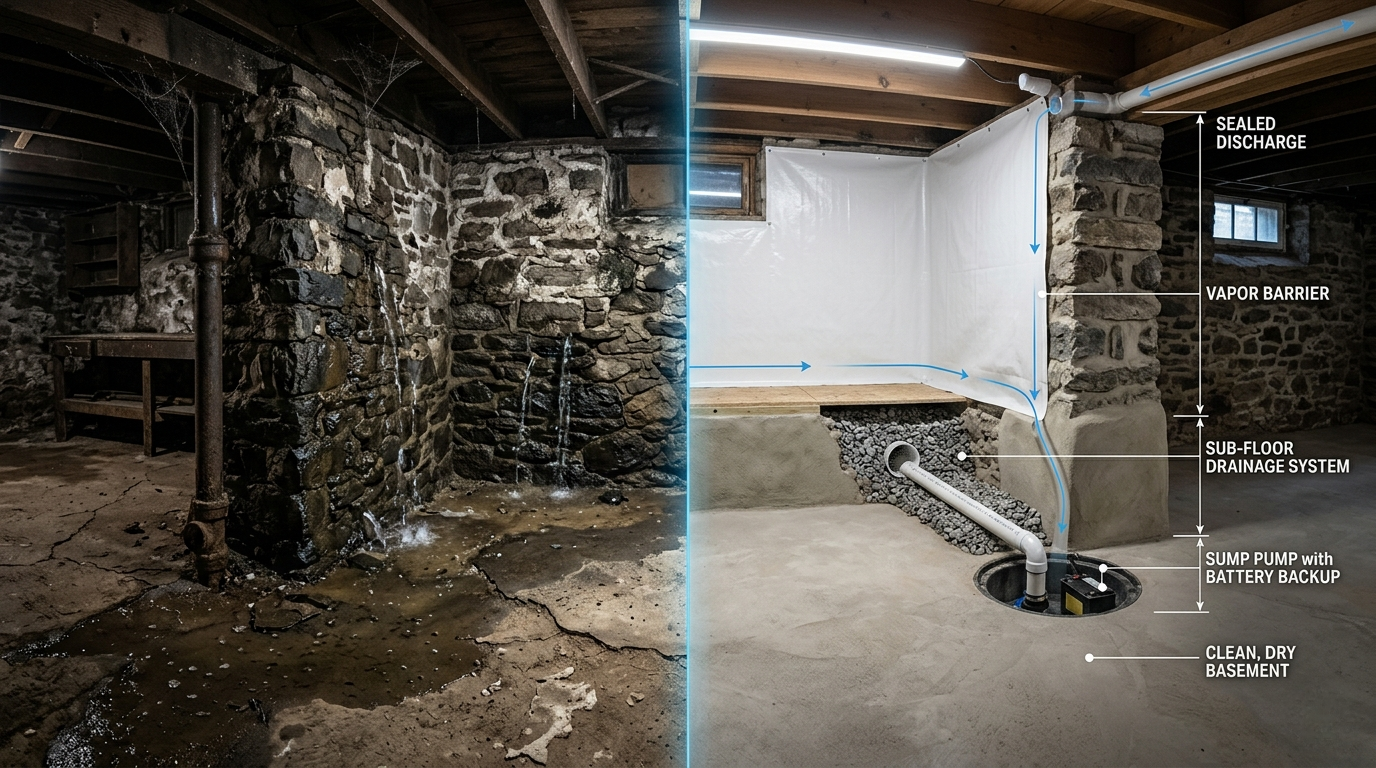
Interior Sub-Floor Drainage Systems (The French Drain)
The most successful, reliable, and cost-effective strategy for treating residential properties in Northeast PA is the installation of an interior sub-floor drainage system.
   [Interior Drainage Cross-Section]

   Existing Wall (Block/Stone) ──► │ █ │
                                   │ █ │ ◄── Drainage Board Redirects Weeping Water
   New Concrete Floor Patch ──► ┌──┘ █ │
                                │ ░░░░ │
   Perforated Drain Pipe ──────►│ ◯ ░░ │ ◄── Washed Clean Crushed Stone Bed
                                └──────┘
- Perimeter Trenching: A technician carefully removes a narrow strip of the concrete floor slab along the perimeter of your basement walls.
- Excavation: A trench is dug down beside the footing of the house, which is the absolute lowest point of the foundation.
- Pipe Placement: A perforated, heavy-duty drainage pipe is wrapped in a filtration fabric and laid inside the trench. The pipe is surrounded by clean, washed crushed stone to facilitate rapid water flow.
- Wall Vapor Flashing: A dimpled plastic drainage board is installed on the lower section of the wall. Any water weeping through the stone or block is instantly captured by this board and directed straight down into the underlying pipe.
- Restoration: The trench is capped back over with fresh concrete, leaving a completely invisible sub-floor drainage channel.
High-Capacity Sump Pump Engineering
An interior drainage pipe is only as good as the system that pumps the water out. The pipe slopes downward toward a heavy-duty sump pump basin. When groundwater fills the basin, a mechanical float switch activates a high-capacity submersible pump, lifting the water up and out of the basement through dedicated discharge lines that empty far away from the foundation.
Because storm events in regions like Stroudsburg and Scranton frequently cause regional grid failures, a professional system must include a battery backup sump pump. This secondary pump runs on an independent, commercial-grade marine battery. If your primary electricity cuts out during a severe mountain thunderstorm, the backup system seamlessly takes over, ensuring your home remains completely safe from rising water tables.
Wall Vapor Barriers and Crawl Space Encapsulation
If your stone or block walls are persistently damp and shedding dust, installing an engineered vapor barrier is highly recommended. These bright white, antimicrobial, heavy-duty plastic sheets are mechanically anchored directly to your foundation walls.
A vapor barrier completely seals the interior living space away from the damp masonry, trapping vapor behind the liner and sending it down into your perimeter drain. This immediately drops the relative humidity in your basement, eradicating musty odors and stopping mold colonization in its tracks. For shallow dirt crawl spaces common under home additions, this process is called encapsulation, creating a clean, completely dry envelope underneath your floorboards.
Why You Need a Local Waterproofing Contractor in NEPA
It can be tempting to reach out to a massive, national home services conglomerate when your home is at risk. However, national franchises frequently rely on standardized, assembly-line procedures that fail to account for the highly specific geologic and structural realities of Northeast Pennsylvania. Working with an experienced, local waterproofing contractor in NEPA offers several critical benefits:
- Geologic Specialization: A local professional understands the unique hydrogeology of our valleys and mountains. They know how our regional clay soils expand and how old mine workings or municipal runoff patterns impact local water tables.
- Architectural Experience: Local contractors have spent decades inside authentic Scranton stone cellars, Wilkes-Barre double-blocks, and Poconos cabins. They know exactly how to handle fragile historic lime mortars and shifting stone footings safely.
- Accountability: A regional business relies entirely on word-of-mouth reputation within the local community. They are invested in providing high-quality work and offering real, dependable warranties that protect your home over the long haul.
Frequently Asked Questions (FAQ)
How much does basement waterproofing cost in Northeast PA?
The cost of waterproofing varies significantly based on the size of the basement, the foundation material (stone vs. cinderblock), and the severity of the water issue. A minor crack injection or localized repair can cost under $1,000, while a comprehensive perimeter interior drainage system with a premium battery backup sump pump typically ranges from $4,000 to $12,000+. A professional inspector can provide a custom, line-item estimate tailored directly to your home’s layout.
Will a dehumidifier fix my wet basement problems?
No. A dehumidifier only removes moisture that has already evaporated into your basement air. It does absolutely nothing to stop hydrostatic pressure from pushing water through your foundation walls. While a dehumidifier is a helpful tool for maintaining ideal humidity levels after a basement has been properly sealed, using one as a primary solution is like trying to empty a leaking boat with a teacup.
Why does my basement leak only during heavy rain or rapid snowmelt?
During heavy rain or rapid snowmelt, the soil surrounding your home becomes temporarily saturated, creating a perched water table. This sudden volume of water creates massive hydrostatic pressure against your foundation. Once the storm passes and the ground naturally drains out, the pressure subsides, which is why the active leaking stops until the next major regional weather event.
Can I waterproof my stone basement from the outside?
While exterior waterproofing is highly effective for modern poured-concrete foundations, it is rarely practical or structurally advisable for older stone basements in NEPA. Excavating a deep trench along a historic stone wall can destabilize the stones, which lack modern footings. Furthermore, regional obstacles like attached porches, paved driveways, and tight property lines in cities like Wilkes-Barre make exterior excavation physically impossible or prohibitively expensive.
Does homeowner’s insurance cover a flooded basement?
Standard homeowner’s insurance policies typically do not cover basement flooding caused by rising groundwater, hydrostatic pressure, or surface water runoff. Insurance generally only covers sudden, accidental internal plumbing failures (like a burst pipe). To protect your home against natural water intrusion, you must install a preventative drainage and pump system.
Reclaim Your Home: Schedule Your Free Inspection Today
You do not have to live with the stress of a damp, unhealthy, or unstable lower level. Every time it storms in Northeast Pennsylvania, you shouldn’t have to worry about checking the basement stairs for standing water. Your home is your most significant financial investment, and it deserves to be anchored on a safe, dry, and structurally sound foundation.
At NEPA Dry Basement, we are dedicated to providing permanent, customized drainage solutions to our neighbors throughout Scranton, Wilkes-Barre, Stroudsburg, Hazleton, and the surrounding communities. We don’t use high-pressure sales tactics or temporary fixes. Our certified, highly experienced inspectors will visit your property, identify the exact root cause of your water intrusion, and map out an honest, clear plan to dry up your basement forever.
Take the first step toward a healthier, more secure home today.